It's one of those home maintenance questions that sounds simple but has a more nuanced answer than most people expect. The honest response is: it depends — on your property, your tree coverage, your roof type, and what Ontario's seasons have been throwing at your home. But there are useful baselines, and there are clear factors that push those baselines up or down.
Most Ontario homeowners don't clean their eavestroughs often enough. The standard recommendation of once a year is a floor, not a ceiling — and for many properties in Hamilton and surrounding communities, once a year leaves gutters in a compromised state for months at a time. The consequences of neglected eavestroughs are slow to appear and expensive when they do: foundation moisture, fascia rot, basement water, and landscaping erosion are all downstream effects of drainage that stopped working properly long before anything visible happened.
This article gives you a practical framework for determining how often your specific property needs eavestrough cleaning, what to look for when you're doing it, and what options exist for reducing how often you need to do it at all.
The Baseline Recommendation for Ontario Homes
The standard guidance for eavestrough cleaning in Ontario is twice per year: once in late spring after tree seeds, blossoms, and early-season debris have finished falling, and once in late fall after the majority of leaves have dropped but before temperatures drop consistently below zero.
This twice-yearly schedule reflects Ontario's specific seasonal pattern. Unlike drier or warmer climates where a single annual cleaning is often sufficient, Ontario's combination of heavy leaf fall, seed and blossom debris in spring, and the risk of frozen blockages heading into winter makes a two-clean schedule the minimum sensible baseline for most properties.
The late-fall timing matters particularly for Ontario homeowners. Eavestroughs heading into winter with accumulated debris are vulnerable to ice dam formation — blockages that prevent snowmelt from draining and cause water to back up under shingles or overflow against fascia boards. A thorough fall clean before the first hard freeze is one of the most cost-effective things you can do to protect your roofline through the cold months.
The goal of a late-fall clean is to send your eavestroughs into winter completely clear — so that snowmelt and early spring rain have an unobstructed path to the downspout from the first thaw onward.
Factors That Require More Frequent Cleaning
The twice-yearly baseline applies to a typical Ontario property with moderate tree coverage and standard asphalt shingles. Several factors — common across Hamilton and surrounding communities — push that frequency higher.
Significant Tree Coverage
This is the single biggest variable in how often eavestroughs need cleaning. A home surrounded by mature deciduous trees can accumulate enough leaf, seed, and twig debris to block gutters within weeks of a cleaning during peak shedding periods. Properties in established Hamilton neighbourhoods — Westdale, Durand, Kirkendall, Ancaster village — with mature tree canopy often benefit from three or four cleanings per year rather than two.
The type of trees matters as well as the quantity. Maples are particularly problematic because they shed in multiple stages: seed pods (helicopters) in late spring, smaller seed clusters through summer, and full leaf fall in autumn. A maple-heavy yard effectively has three distinct debris seasons. Oak trees hold their leaves later than most deciduous species, meaning fall debris drops into November — often after homeowners assume the cleaning season is over. Pine and spruce shed needles year-round, and needle accumulation in eavestroughs creates a dense, moisture-retaining mat that blocks drainage more effectively than loose leaves.
Roof Type and Pitch
Asphalt shingles shed granules — the small mineral particles that coat the shingle surface — throughout their lifespan, and this shedding accelerates as shingles age. Those granules accumulate in eavestroughs and contribute to blockages, particularly when combined with organic debris. A roof in the latter half of its lifespan will add measurably more granule debris to your gutters each year, pushing the cleaning frequency up.
Roof pitch also affects how debris accumulates. A steeply pitched roof sheds material more actively with each rain event, concentrating debris at the gutters faster than a low-slope roof where material tends to stay put until wind or water moves it. Homes with complex rooflines — multiple valleys, dormers, multiple ridges — accumulate debris at valley points that funnel directly into specific gutter sections, creating localized blockage hotspots even when the rest of the system is clear.
Proximity to Other Properties and Wind Patterns
You don't need to be directly under trees to receive their debris. Prevailing winds in Hamilton carry leaf and seed material significant distances from source trees — a property without a single tree can receive substantial debris from neighbours' or nearby park trees depending on wind direction and speed. West and southwest-facing roof slopes tend to accumulate the most wind-carried debris given Hamilton's prevailing wind patterns off Lake Erie and Lake Ontario.
Previous Blockage or Drainage Problems
A property that has had eavestrough blockages in the past is more likely to experience them again — not because the gutters are defective, but because the same environmental conditions that caused the first blockage continue to apply. If you've had overflow events, water staining on your foundation, or blockages identified during a professional cleaning, that's a signal to clean more frequently rather than waiting to see if it recurs.
Nearby Construction
Active construction on adjacent properties generates airborne debris — sawdust, insulation fibres, fine particulate from cutting materials — that settles in eavestroughs and combines with organic material to create particularly dense blockages. If there is ongoing construction in your neighbourhood, adding an extra inspection and cleaning during the active construction period is worth considering.
When to Clean: Timing Through the Ontario Calendar
Late Spring — May to Early June
The first clean of the year addresses everything that fell through the winter and early spring: leaves that survived the winter as decomposing organic matter, seed pods and blossoms from spring-flowering trees, and any debris that washed in during snowmelt and early spring rains. This is also the right time to run a garden hose through the system to test for slope and drainage issues that may have developed over winter — a sagging bracket, a joint that separated during freeze-thaw, or a downspout elbow that has shifted.
Spring cleaning sets your system up for the heavy rainfall season that typically runs from May through July in Ontario. A clean, properly functioning eavestrough entering this period makes a measurable difference in how your foundation and basement fare through wet months.
Late Summer — August to September
Not every property needs a mid-season clean, but those with heavy tree coverage — particularly maples with their late summer seed drop — benefit from an additional inspection and cleaning in August or September. This timing catches the late-summer debris load before it compounds with fall leaf drop, preventing the buildup from reaching a density that strains downspout capacity during the heavy fall rains that precede leaf season.
This is also a good window to inspect the condition of the gutters themselves before winter: check for joint separations, loose hangers, and any sections that have developed a reverse pitch since the spring clean.
Late Fall — November, After Peak Leaf Drop
The most important clean of the year for Ontario homeowners. The timing window here requires judgment: you want to wait until the majority of leaves have dropped — typically mid to late November in the Hamilton area — but clean before temperatures drop consistently below zero, which makes the work both more difficult and less effective.
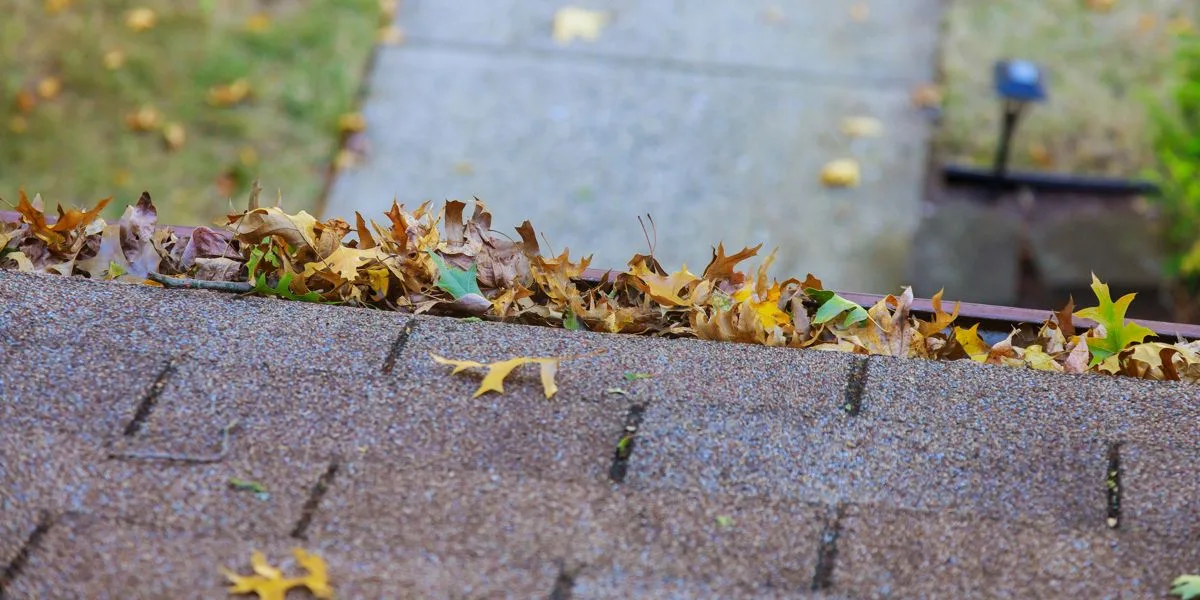
A thorough late-fall clean means clearing the full length of every eavestrough run, clearing all downspouts, and verifying that water flows freely from the high end of each run to the downspout exit. Debris left in gutters over winter becomes water-saturated, freezes into a solid mass, and can add enough weight to pull hanger brackets away from fascia boards. It also creates the conditions for ice dam formation at the eaves — one of the more damaging winter roofline events for Ontario homes.
If you can only do one eavestrough cleaning per year, make it late fall. A clear system heading into an Ontario winter does more to protect your home than a spring clean on a system that has already been through a blocked winter.
What a Proper Eavestrough Cleaning Actually Involves
Eavestrough cleaning is straightforward in principle but often done incompletely in practice — particularly when homeowners are working quickly or working from an angle that doesn't give them a clear view into the gutter. A thorough cleaning covers several steps beyond simply removing visible debris.
- Full debris removal: Every section of the eavestrough run should be cleared of leaves, seed material, granules, and any compacted organic matter. Debris that has sat through a wet season compacts into a paste that won't flush out with a hose — it needs to be manually scooped from the trough.
- Downspout clearing: A common incomplete cleaning leaves debris-free gutters draining into blocked downspouts. Each downspout should be flushed with a hose from the top while watching for water to exit cleanly at the bottom. Slow or absent flow indicates a blockage inside the downspout, typically at an elbow or joint.
- Flow testing: Run a hose from the high end of each eavestrough run and observe how water moves toward the downspout. Pooling at any point indicates a slope problem — either a sagging section or a hanger that has allowed that section to pitch the wrong direction.
- Joint and hanger inspection: While working along the eavestrough, check each visible joint for separation or leaking, and each hanger bracket for secure attachment to the fascia. A hanger that has pulled even slightly away from the fascia will allow the gutter to move under load, accelerating further separation.
Downspout exit check: Verify that each downspout terminates with a splash block or extension that directs water at least a metre or two away from the foundation. A downspout discharging directly against the foundation wall or into a settled low spot undoes much of the benefit of having a clean system above.
DIY Cleaning vs. Professional Service
Eavestrough cleaning is one of the more accessible home maintenance tasks for homeowners comfortable working on a ladder — but it comes with genuine risks and limitations worth understanding before deciding how to approach it.
When DIY Makes Sense
Single-storey homes with straightforward rooflines, easily accessible eavestroughs, and moderate debris loads are reasonable candidates for DIY cleaning. A stable ladder, gloves, a gutter scoop or garden trowel, and a garden hose are the basic tools required. The work is physically demanding but not technically complex, and doing it yourself gives you a close look at the condition of your gutters, hangers, and fascia that you might not otherwise get.
When Professional Cleaning Makes More Sense
Multi-storey homes, steep or complex rooflines, properties with significant tree coverage requiring multiple cleanings per year, and any situation where safe ladder access is a concern are all good candidates for professional service. A professional cleaning also typically includes a basic inspection of the gutter system's condition — hanger integrity, joint sealing, slope — that a homeowner working from a ladder may miss.
The cost of a professional eavestrough cleaning is modest relative to the cost of the water damage that a blocked system can cause. For many homeowners, particularly those managing multi-storey properties or heavy tree coverage, professional cleaning is the more practical and safer choice.
Reducing Cleaning Frequency with Leaf Guards
For properties with significant tree coverage — the ones where twice-yearly cleaning still isn't quite keeping up — leaf guard systems offer a meaningful reduction in cleaning frequency and the associated maintenance burden.
Leaf guards are systems installed over or inside the eavestrough opening that allow water to enter while blocking or deflecting debris. Quality leaf guard products don't eliminate the need for cleaning entirely — some fine debris, shingle granules, and seed material will still make it through or accumulate on the guard surface — but they dramatically reduce the volume of material that reaches the gutter interior and the frequency with which attention is needed.
For Oakville and Burlington homeowners managing properties with mature tree canopies, and for Hamilton properties in older neighbourhoods with significant street tree coverage, leaf guards are one of the most practical investments available for reducing ongoing exterior maintenance demands.
The right leaf guard product depends on your specific debris type, roof pitch, and eavestrough profile. Not all products perform equally well with needle debris versus leaf debris, and installation quality matters as much as product selection. A professional assessment of your specific situation will give you a clearer picture of whether leaf guards make sense for your property and which type is best suited to your conditions.

Signs Your Eavestroughs Need Cleaning Right Now
Between scheduled cleanings, a few visible signs indicate that your gutters need attention before the next scheduled date:
- Water overflowing the front edge of eavestroughs during or after rainfall — the clearest indicator of a blockage or drainage failure
- Plants or moss growing visibly inside the eavestrough — indicates debris has accumulated to a depth that supports growth
- Sagging sections that were not present after the last cleaning — weight of waterlogged debris is pulling hangers away from the fascia
- Water staining on fascia boards or siding below the eavestrough line — indicates overflow has been occurring repeatedly
- Visible debris — leaves, seed material, compacted matter — visible above the eavestrough lip from the ground
- No water exiting downspouts during or after a rain event despite visible flow in the trough above — blocked downspout
Any of these signs during the active rainfall season means your eavestroughs are not draining properly right now — not that they might have a problem eventually. Address these promptly to prevent overflow damage from compounding through the next rain event.
Professional Eavestrough Cleaning and Service Across Hamilton
Mario Aluminum provides professional eavestrough cleaning, inspection, and repair for homeowners across Hamilton, Stoney Creek, Burlington, Oakville, Ancaster, and Waterdown. Our cleaning service includes full debris removal, downspout flushing, flow testing, and a basic condition assessment of hangers, joints, and fascia — giving you a clear picture of your system's health at each visit.
If your cleaning reveals issues that need attention — a sagging section, a failing joint, fascia that has softened behind the gutter — we can assess and quote repairs at the same visit, saving you a separate appointment.
We also supply and install leaf guard systems for properties where reducing cleaning frequency is a priority. If you're tired of managing heavy debris loads multiple times per year, a leaf guard consultation is a practical next step.
The best time to schedule a cleaning is before you need one urgently — before the peak of fall leaf drop, before the first hard freeze, or before the heavy spring rainfall season. Booking in advance means better availability and a system that's ready before the weather demands it.
Call us at (289) 993-5566 or request a free quote online to schedule your eavestrough cleaning or to ask about leaf guard installation for your property.
Contents

- The Baseline Recommendation for Ontario Homes
- Factors That Require More Frequent Cleaning
- When to Clean: Timing Through the Ontario Calendar
- What a Proper Eavestrough Cleaning Actually Involves
- DIY Cleaning vs. Professional Service
- Reducing Cleaning Frequency with Leaf Guards
- Signs Your Eavestroughs Need Cleaning Right Now
- Professional Eavestrough Cleaning and Service Across Hamilton