Article Summary
When replacing eavestroughs, Ontario homeowners face a choice between two fundamentally different systems: seamless aluminum and sectional gutters. This article delivers a direct, honest comparison across the four dimensions that matter most in our climate: leak points and joint failure, expected lifespan, upfront and long-term cost, and performance through Ontario's freeze-thaw winters. The goal is to give Hamilton-area homeowners the information they need to make a confident, well-informed decision before committing to an installation.
When Ontario homeowners replace their eavestroughs, most conversations focus on timing and budget. The choice between system types receives far less attention, even though it is one of the decisions with the greatest impact on long-term performance and maintenance cost.
The two systems available to most homeowners are sectional eavestroughs, which have been the standard for decades, and seamless aluminum eavestroughs, which have become increasingly prevalent as their performance advantages are better understood. They look similar once installed. They serve the same fundamental purpose. But they differ significantly in how they handle Ontario's climate, how long they last, and how much attention they need over time.
This comparison covers the four dimensions that matter most for Hamilton-area homeowners: where each system is vulnerable to failure, how each performs through freeze-thaw winters, what each costs upfront and over time, and what kind of maintenance each demands. By the end, the right choice for your property should be clear.
Understanding the Two Systems
Sectional Eavestroughs
Sectional eavestroughs are assembled from pre-cut lengths of aluminum, vinyl, or steel, typically ranging from three to four metres per section. These lengths are joined together using connectors and sealed with a silicone or butyl-based sealant, creating a continuous run from one end to the other. The result is a system with joints at regular intervals along its length, typically every three to four metres, plus additional connections at corners, downspout openings, and end caps.
Sectional systems have been the dominant installation method in Ontario for generations. They are stocked at building supply retailers, relatively straightforward to install, and available in a range of profiles and materials. For many decades, they were the only practical option for residential eavestrough installation.
Seamless Aluminum Eavestroughs
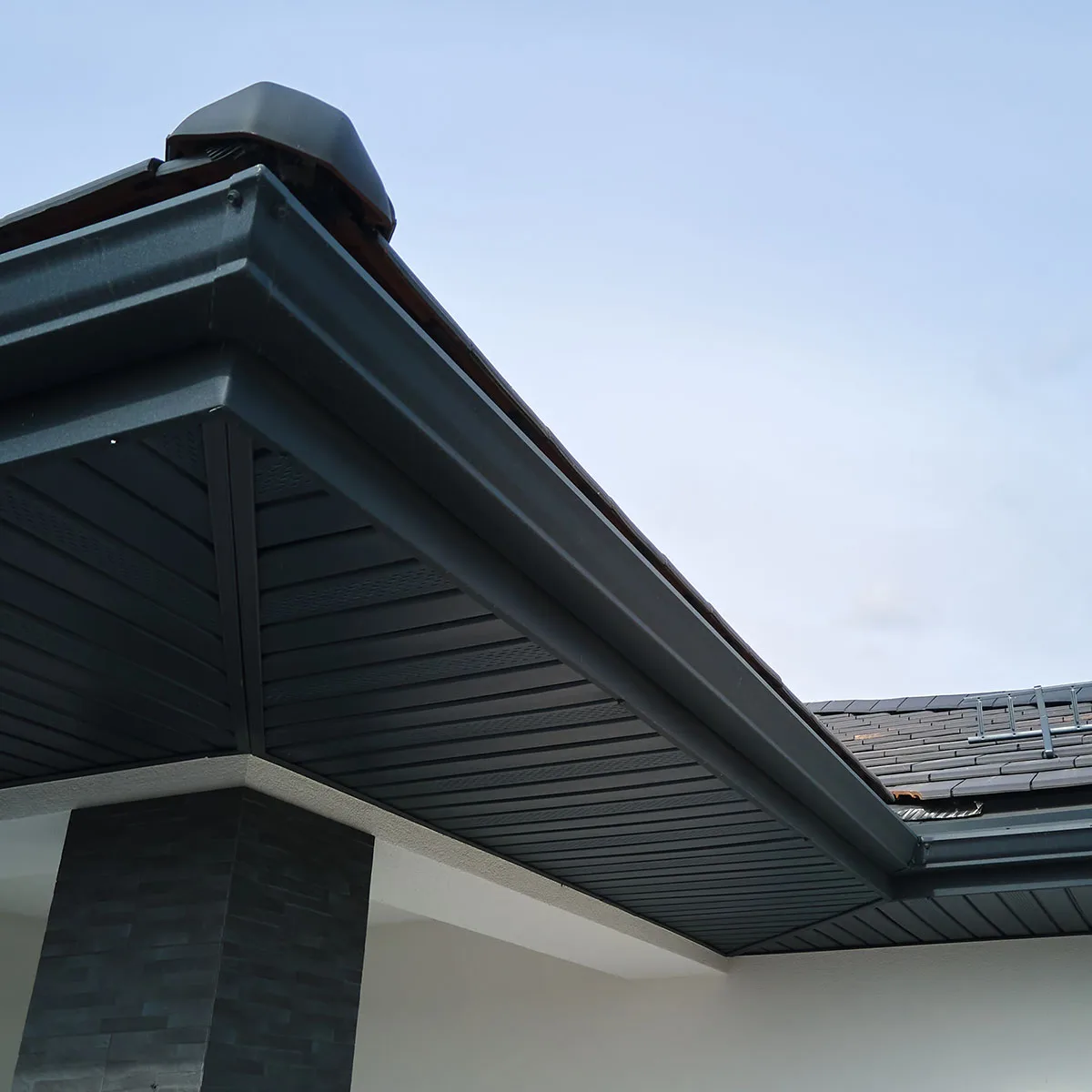
Seamless aluminum eavestroughs are fabricated on-site using a portable roll-forming machine that extrudes a continuous length of aluminum cut to the exact measurement of each run on your home. Rather than joining pre-cut sections with connectors, the entire length from one end to the other is a single, unbroken piece of aluminum. Joints exist only where they are structurally unavoidable: at inside and outside corners, and at downspout connections.
Because seamless systems require specialized equipment and on-site fabrication, they are installed exclusively by trained contractors. The material is typically heavier-gauge aluminum than most sectional products, contributing to additional structural rigidity alongside the absence of mid-run joints.
Leak Points: Where Each System is Vulnerable
The most consequential difference between seamless and sectional eavestroughs is the number of potential leak points each system contains. Understanding where and why eavestroughs leak is central to making a well-informed choice.
The Joint Problem in Sectional Systems
Every joint in a sectional eavestrough system is a sealed connection between two pieces of material. That seal is created by a sealant that has a finite service life. Most eavestrough sealants remain effective for five to ten years before UV exposure, thermal cycling, and physical movement begin to degrade them. As the sealant breaks down, the joint develops micro-gaps that water can penetrate.
On a typical single-storey Hamilton home, a sectional eavestrough system may have fifteen to twenty-five joints across all runs, depending on the home's perimeter. Each of those joints is a future maintenance point. The progression is predictable: sealant degrades, joints leak, water contacts the fascia behind the gutter, and fascia damage accelerates. For homeowners who stay on top of maintenance, resealing joints every five to seven years keeps the system functional. For those who do not, joint failure cascades into fascia damage, and fascia damage compromises the anchor for the entire eavestrough system.
Where Seamless Systems Still Have Joints
Seamless eavestroughs are not entirely joint-free. Corners and downspout connections require sealed joints, as do the end caps at the terminus of each run. The critical difference is the absence of mid-run joints along straight sections, which is where the overwhelming majority of sectional system failures originate. A seamless system on the same home that would have twenty sectional joints might have four to six sealed connections in total, each at a location where a joint is genuinely necessary rather than a consequence of pre-cut material lengths.
The fewer joints a system has, the fewer future failure points it carries. Seamless eavestroughs do not eliminate every sealed connection, but they eliminate the majority of them, which is where most eavestrough problems begin.
Performance Through Ontario's Winters
Southern Ontario's climate creates specific demands on eavestrough systems that homeowners in more stable climates do not face. The combination of freeze-thaw cycling, significant snow and ice load, and lake-effect precipitation pushes both systems differently.
How Freeze-Thaw Cycling Affects Each System
Every freeze-thaw cycle subjects eavestrough materials to thermal expansion and contraction. Aluminum expands when temperatures rise above zero and contracts when they fall below. In a sectional system, this movement is concentrated at joints, where two pieces of material are attempting to move independently while held together by a connector and sealant. Over dozens of cycles across a single winter, that repeated micro-movement works the joint, fatiguing the sealant and progressively loosening the connection.
In a seamless system, the same thermal movement occurs across the full length of the run rather than being concentrated at joints. The hanger brackets that secure the eavestrough to the fascia are designed to allow for this linear movement, and without mid-run joints to fatigue, the system handles cycling significantly better over time.
Ice and Snow Load
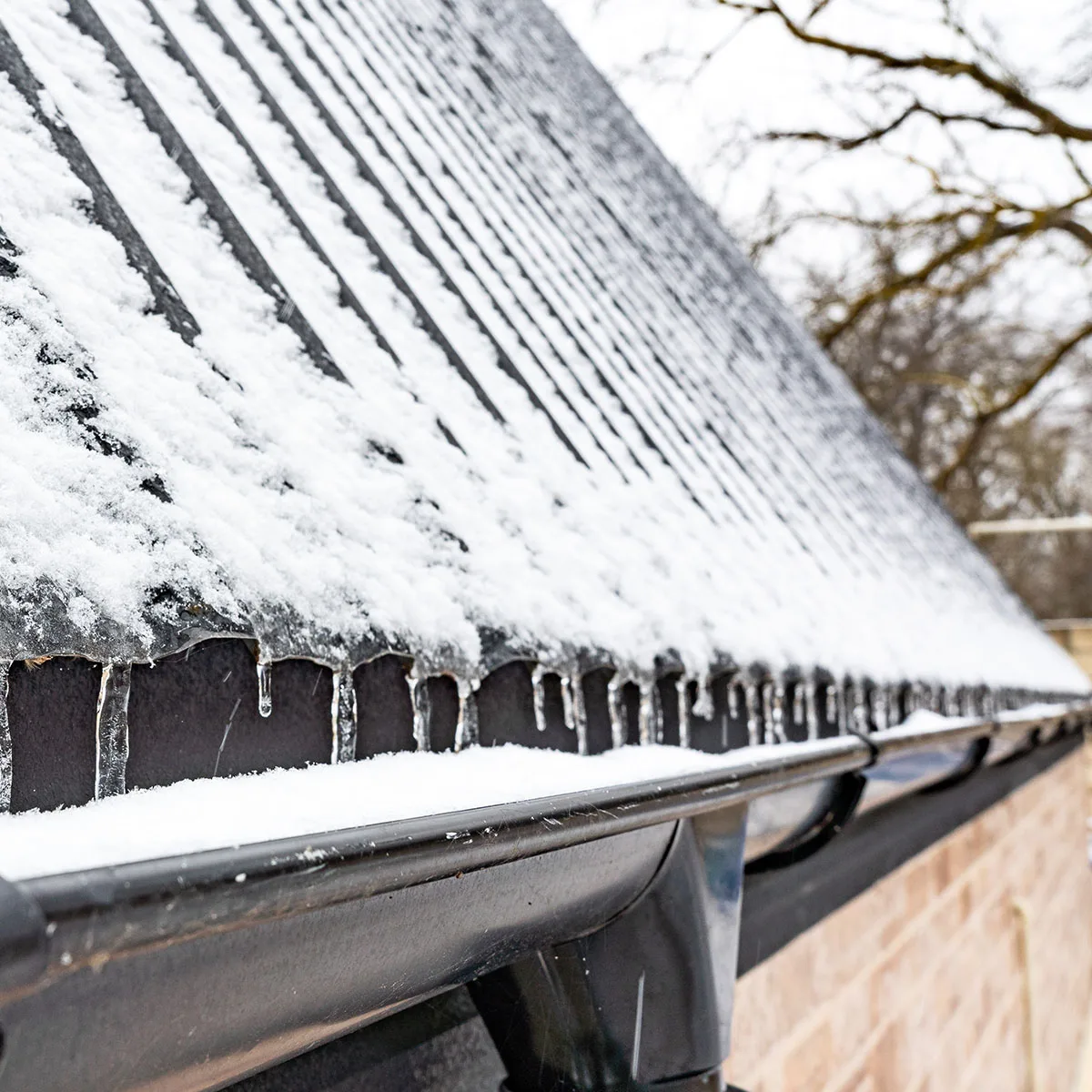
Hamilton receives significant snowfall, including lake-effect events that can deposit heavy accumulation in short periods. That snow sits in and on eavestrough systems, adding weight that stresses both the hanger bracket connections to the fascia and the joints within the system. The heavier gauge aluminum used in most seamless systems provides greater structural rigidity under this load than the lighter material common in many sectional products. Joints under ice load are also particularly vulnerable: ice that forms within a joint can expand with enough force to complete a separation that thermal cycling had already begun.
Ice Dam Interaction
Ice dams, which form when heat escaping through a poorly ventilated attic melts roof snow that then refreezes at the cold eaves, place significant stress on the eavestrough system at the roofline. The weight and force of ice dam formation can pull eavestrough sections away from the fascia, particularly at joints and hanger points that have already been weakened by thermal cycling. The structural advantage of seamless systems is most evident here: a continuous run with fewer joints and heavier-gauge material is better equipped to withstand ice dam formation without joint separation or hanger failure.
Expected Lifespan in Ontario's Climate
Lifespan comparisons between eavestrough systems require some qualification because both systems can last for decades with appropriate maintenance, and both can fail prematurely with neglect. That said, the structural differences between the two systems produce measurably different typical lifespans under comparable maintenance conditions.
Sectional Systems
Well-maintained sectional aluminum eavestroughs typically last fifteen to twenty-five years in Ontario's climate. The constraint is usually not the aluminum itself, which resists corrosion effectively, but the sealant at the joints. As joints are resealed repeatedly over the years, the surrounding aluminum can become scored or deformed, making new sealant adhesion progressively less reliable. At some point, the cost and frequency of maintenance makes replacement more economical than continued repair. Vinyl sectional systems have a shorter effective lifespan in Ontario because vinyl becomes brittle at low temperatures, making it more susceptible to cracking under impact and ice load.
Seamless Aluminum Systems
Seamless aluminum eavestroughs in Ontario typically last twenty-five to forty years with basic maintenance. The absence of mid-run joints removes the primary failure mechanism that limits sectional system lifespan. The remaining joints at corners and downspout connections require occasional attention, but their lower number means maintenance is less frequent and less intensive. The heavier gauge aluminum also contributes to longevity by resisting deformation under ice and snow load more effectively than lighter sectional material.
For Hamilton homeowners planning to stay in their property long-term, the lifespan difference between seamless and sectional systems often means the difference between one replacement and two over the life of the home.
Cost: Upfront vs. Over Time
Cost is typically the first question homeowners ask when comparing the two systems, and it deserves a careful answer because the upfront comparison and the long-term comparison point in different directions.
Upfront Cost
Sectional eavestroughs carry a lower upfront installation cost. The material is less expensive, and the installation process is faster since it does not require on-site fabrication equipment. For a homeowner primarily focused on minimizing the initial project cost, sectional is the lower-cost option.
Seamless aluminum eavestroughs carry a higher upfront cost, reflecting both the heavier-gauge material and the specialized equipment and expertise required for on-site fabrication. The premium varies depending on the size and complexity of the home, but homeowners should expect to pay meaningfully more for seamless installation than for a comparable sectional system.
Long-Term Cost
The long-term cost picture reverses the upfront comparison. Sectional systems require regular joint resealing, typically every five to seven years, to maintain performance. Each resealing cycle carries both material and labour cost, and any joint failure that is not caught promptly adds fascia repair to the expense. Over a fifteen to twenty-year period, the cumulative maintenance cost of a sectional system can close a significant portion of the gap with the higher seamless installation cost.
Seamless systems require far less maintenance over their service life. The corners and downspout connections that do require sealant attention are few in number and straightforward to access. For homeowners who factor in the cost of maintenance rather than just the upfront installation, seamless aluminum frequently represents the better value over the life of the system.
Side-by-Side Comparison
| Seamless Aluminum | Sectional | |
|---|---|---|
| Joints in a typical run | None along straight sections | Every 3 to 4 metres |
| Primary leak risk | Corners and downspout connections | Every mid-run joint |
| Typical lifespan (Ontario) | 25 to 40 years | 15 to 25 years |
| Freeze-thaw performance | Excellent | Moderate |
| Ice load resistance | Strong (heavier gauge) | Variable (lighter gauge) |
| Upfront cost | Higher | Lower |
| Long-term maintenance cost | Low | Moderate to high |
| Material options | Aluminum only | Aluminum, vinyl, steel |
| Installation method | On-site fabrication | Pre-cut sections |
| Available from DIY stores | No | Yes |
When Sectional Eavestroughs May Still Make Sense
An honest comparison requires acknowledging that sectional systems are not without legitimate applications. There are situations where sectional remains a reasonable choice.
- Budget-constrained projects where the upfront cost difference is a genuine constraint and the homeowner is committed to regular maintenance
- Smaller, simpler structures where the total number of joints is limited and maintenance access is straightforward
- Short-term ownership situations where the homeowner does not plan to be in the property long enough for the long-term cost comparison to be relevant
- Partial replacement situations where matching an existing sectional system is preferable to a full replacement
For most Hamilton homeowners planning a full eavestrough replacement on a standard residential property, however, the performance, lifespan, and long-term value advantages of seamless aluminum make it the stronger recommendation in Ontario's climate.
Frequently Asked Questions
Aluminum is the stronger material choice for Ontario’s climate. Vinyl becomes brittle at low temperatures, which increases the risk of cracking under impact from ice, hail, or falling debris during winter months. Aluminum retains its flexibility and structural integrity across the full temperature range Ontario experiences, from summer heat to winter cold, and handles the weight of ice and snow loads more effectively. Most professional eavestrough contractors in Southern Ontario recommend aluminum for this reason.
Yes. Leaf guard systems are fully compatible with seamless aluminum eavestroughs and can be installed at the same time as a new seamless system or retrofitted to an existing one. The combination of seamless eavestroughs and leaf guards represents the most maintenance-efficient eavestrough solution available for Ontario properties with significant tree coverage, dramatically reducing both the frequency of cleaning and the risk of blockage-related overflow.
A typical residential seamless eavestrough installation is completed in a single day for most homes. The on-site fabrication process is efficient: the roll-forming machine extrudes the aluminum to the measured length of each run, and the installation crew fits and secures the system the same day. More complex homes with multiple levels, dormers, or unusually long runs may require an additional half-day.
Seamless eavestroughs do not have mid-run joints that require periodic resealing, which is the primary maintenance task on sectional systems. However, the corners, end caps, and downspout connections do use sealant that should be inspected periodically and resealed when deterioration is visible. In practice, this is a significantly smaller maintenance commitment than a sectional system requires because the number of sealed connections is a fraction of what a sectional run contains.
Yes. Seamless aluminum eavestroughs are available in a wide range of standard colors and can often be color-matched to your existing siding, soffit, or fascia. The aluminum is coated with a factory-applied finish before the roll-forming process, so the color runs through the full length of the fabricated run. Your installer can provide a color range at the time of quoting, and custom matching is available in most cases.
Making the Right Choice for Your Hamilton Home
The decision between seamless and sectional eavestroughs comes down to a single honest question: are you optimizing for the lowest upfront cost, or the best long-term performance and value for your home?
For the majority of Hamilton-area homeowners planning a full eavestrough replacement, seamless aluminum delivers a superior outcome on every metric that matters over time: fewer leak points, longer lifespan, better performance through Ontario winters, and lower cumulative maintenance cost. The higher upfront investment pays for itself over the life of the system.
At Mario Aluminum, we have been installing seamless aluminum eavestroughs across Hamilton, Stoney Creek, Burlington, Oakville, Ancaster, and Waterdown for over 20 years. We fabricate every run on-site to the exact dimensions of your home, and we stand behind our installations with the confidence that comes from two decades of delivering durable exterior solutions built for Ontario conditions.
If you are ready to replace your eavestrough system and want to understand exactly what seamless aluminum installation involves for your property, we would be glad to provide a free on-site assessment and quote. There is no obligation, and we will give you an honest recommendation regardless of which direction makes the most sense for your home.
Every Mario Aluminum eavestrough installation is custom-fabricated on-site. Because a system built to fit your home performs better than one assembled from pre-cut sections.
Call us at (289) 993-5566 or request a free quote online to schedule your siding assessment.
Contents

- Understanding the Two Systems
- Leak Points: Where Each System is Vulnerable
- Performance Through Ontario's Winters
- Expected Lifespan in Ontario's Climate
- Cost: Upfront vs. Over Time
- Side-by-Side Comparison
- When Sectional Eavestroughs May Still Make Sense
- Frequently Asked Questions
- Making the Right Choice for Your Hamilton Home